
What is vitiligo?
When someone notices a change in skin colour in certain areas, they may feel concerned and wonder whether it is vitiligo. Vitiligo is a chronic skin condition associated with the immune system and the loss of pigment-producing cells, which can reduce skin colour in affected areas. However, this overall mechanism does not mean that a single factor explains the symptoms of every patient [1] [2].
This article summarizes information to help explain what may cause vitiligo, how vitiligo may be treated, and the limitations of the available information. It is not a substitute for diagnosis or an individualized treatment plan.

Symptoms and types of vitiligo
Vitiligo may have different patterns of distribution in areas where skin colour has changed. Classifying the condition can help a physician assess the overall pattern, but the type should not be determined from self-observation alone [1].
Commonly discussed types include segmental vitiligo and non-segmental vitiligo. Segmental vitiligo has clinical features and mechanisms that differ from non-segmental vitiligo, and somatic mosaicism is an important hypothesis that may help explain this difference. However, the relationship between mosaicism and direct causation has not been settled, and mixed features may occur [3] [1].
For children with vitiligo, it is important to assess the type, activity, and effects of the condition comprehensively. Some treatment evidence comes from specific populations, so findings from adults should not automatically be applied to children [4] [5].
What causes vitiligo?
There is no single answer to what causes vitiligo. The condition is associated with the immune system and the loss of pigment-producing cells, and several processes may act together in each person [1] [2].
At the mechanistic level, evidence suggests that oxidative stress, CD8+ immune cells, the IFN-gamma/JAK-STAT axis, and tissue-resident memory T cells, or TRM, may have roles in the development or persistence of the condition. This evidence helps researchers understand possible directions for study, but it does not prove that inhibiting any one pathway will improve symptoms in every patient [2] [6] [7].
Ferroptosis, a form of cell death, is another topic of research interest. It should not yet be interpreted as a confirmed mechanism in humans or as a current standard treatment [8].
Assessment and diagnosis
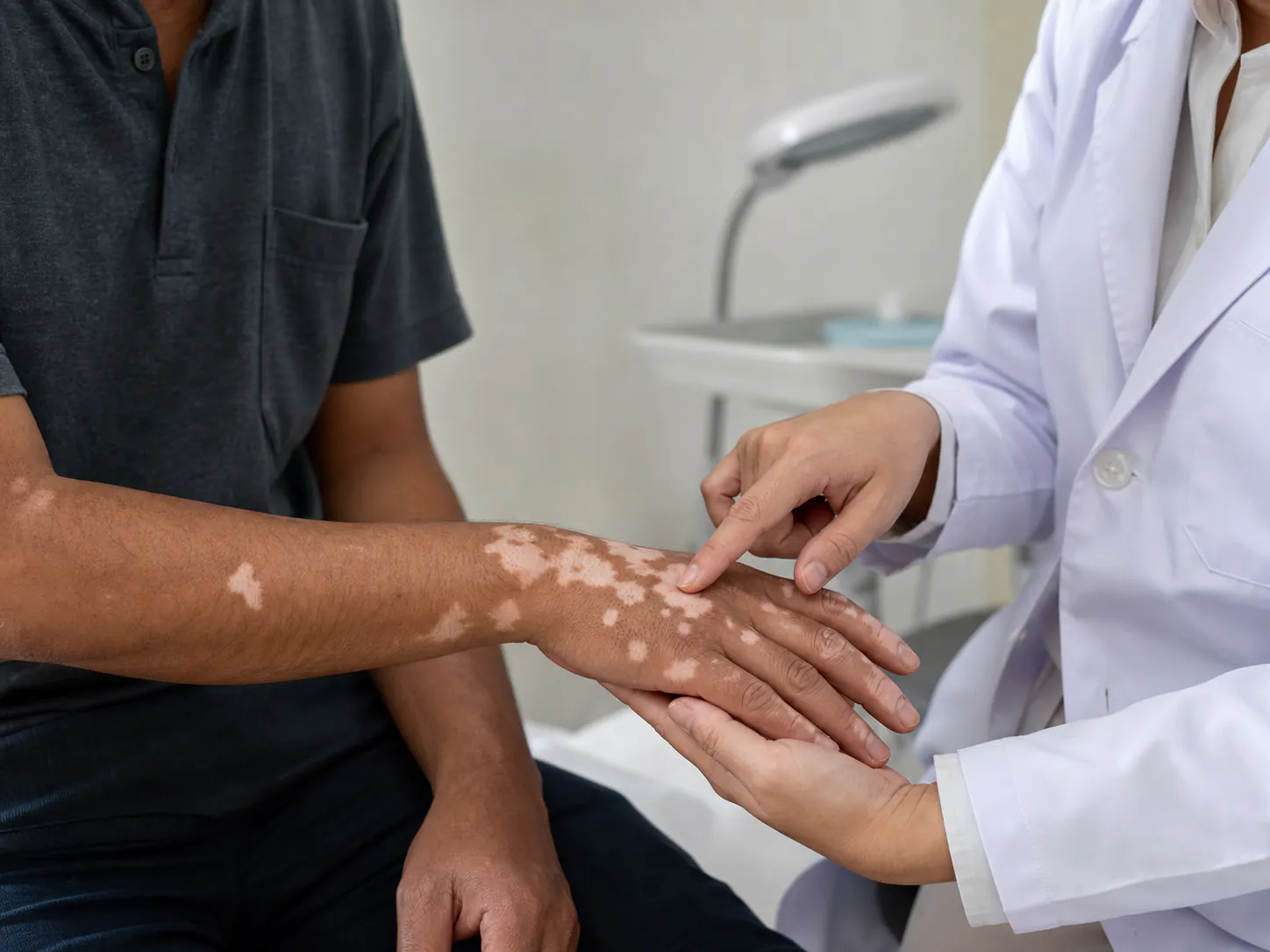
Diagnosing vitiligo usually relies on a clinical assessment by a dermatologist, including consideration of the characteristics and distribution of the changes in the context of each patient [1].
AI may currently help distinguish vitiligo from other hypopigmented conditions in research, but study findings come from specific image sets and contexts. AI should therefore not yet replace a physician or an assessment of a real patient. If an area of skin changes colour, examination by a physician can support more appropriate planning for further assessment [9] [10].
Treatment goals
There is no single approach to vitiligo treatment that is suitable for everyone. A physician will consider disease activity, the extent and location of the changes, age, and the patient's needs so that appropriate goals and options can be agreed together [11] [12].
Care goals may include controlling the loss of skin colour, promoting the return of skin colour, and ongoing follow-up. Outcomes and expectations should therefore be discussed in relation to each person's disease characteristics [1] [11].
Treatment options with a current role
Topical corticosteroids (TCS) and topical calcineurin inhibitors (TCI) are standard options with different roles. With continued use, TCS require consideration of skin atrophy, while TCI are often used on sensitive areas. Potency, duration, and application site should be assessed by a physician rather than selected independently as a one-size-fits-all regimen [12] [13] [14].
Evidence for ruxolitinib cream comes from randomized trials in patients with non-segmental vitiligo and limited affected body surface area, and response may increase when assessed over a longer period. This evidence applies to adolescents and adults whose affected area did not exceed the study criteria; it should not be used to guarantee outcomes in every patient group [15] [16] [11].
NB-UVB is commonly used and also has a role in children, but patient selection and long-term safety monitoring remain important. Outcomes may differ by disease type, location, and treatment consistency [5] [17].
Pigment-cell transplantation surgery may be considered for people with stable disease. Outcomes vary by technique, location, and patient selection, so it is not an option for every case of actively progressing disease [18] [19] [20] [4].
Approaches still under investigation: Combining a JAK inhibitor with NB-UVB may increase the return of skin colour compared with NB-UVB alone in adults with non-segmental vitiligo, but the pooled analysis included a limited number of studies and patients, and treatment regimens and follow-up periods differed [21] [22] [23].
Oral JAK inhibitors, including povorcitinib and certain other medicines, have preliminary supporting information in some patient groups. Most of the evidence, however, is observational or comes from small reports, and more long-term data are needed. They should therefore not yet be presented as standard treatment [24] [25] [26] [27] [28] [29].
Approaches targeting IL-15 or TRM are also topics of research interest, but long-term effectiveness in humans has not been confirmed. A trial's completed status does not mean that its results have been confirmed [30] [31] [32] [6].
Limitations, side effects, and recurrence
Vitiligo treatment outcomes may differ by lesion location, particularly in acral areas, and results from one location should not be used to predict results at every location. Recurrence after treatment can occur. One retrospective study found that acral lesions, thyroid disease, or coexisting autoimmune disease were associated with a higher risk of recurrence, but this is an association, not an individualized prediction or evidence of cause and effect [33] [34].
The durability of skin colour after stopping ruxolitinib and the role of maintenance treatment remain uncertain because outcomes depend on the follow-up period and population in each study [35] [36] [37].
Available observational data have not shown a clear association between TCI use and an increased risk of cancer, but this does not mean that the risk is zero. Retrospective studies have limitations in follow-up duration and confounding factors [38] [39].
For phototherapy, a pooled analysis in patients with vitiligo found no clear signal that phototherapy increases the risk of skin cancer, but UV exposure and long-term follow-up should still be considered [40] [5] [41].
Topical JAK inhibitors may have low systemic absorption, and reported data did not find significant accumulation. This should not be interpreted as meaning there is no systemic risk at all, nor should warnings for oral JAK inhibitors be applied directly to topical JAK inhibitors [42] [43] [44].
Effects on quality of life
The question of whether vitiligo is dangerous may not be answered by considering the skin alone. The condition is associated with quality-of-life burden, stigma, anxiety, and depression, with effects that vary by location, skin colour, age, and social context [45] [46] [47] [48].
Much of the evidence comes from observational or cross-sectional studies, so it should not be concluded that vitiligo directly causes psychological conditions in every patient. Concerns, reduced confidence, or effects on daily life can nevertheless be discussed during an assessment [46] [47] [48].
When should you see a dermatologist?
If you notice a change in skin colour, have symptoms that concern you, or are unsure whether the change is vitiligo or another condition, arrange an appointment with a dermatologist for an appropriate assessment. Diagnosis usually relies on clinical assessment, and AI remains only an assistive tool in limited contexts [1] [9] [10].
Preparing questions about how symptoms have changed, their effects on daily life, and expectations for care can help a physician consider options comprehensively according to disease activity, extent, location, age, and the patient's needs. You do not need to make treatment decisions by yourself before the assessment [11] [12].
Key points
- Vitiligo is a chronic skin condition associated with the immune system and the loss of pigment-producing cells.
- Diagnosis should rely on a clinical assessment by a dermatologist, and AI is not yet a substitute for assessing a real patient.
- Treatment choice depends on disease activity, extent, location, age, and the patient's needs.
- Outcomes, safety monitoring, and the likelihood of recurrence vary, so an individualized care plan should be discussed with a physician.
References
- Vitiligo.
- Molecular Pathogenesis of Vitiligo: Emerging Roles of Epigenetic Regulation.
- Segmental Vitiligo and Somatic Mosaicism: From Pathogenesis to Therapeutics.
- Shining Light on Treatments: A Systematic Review of Existing Therapies for Pediatric Segmental Vitiligo.
- The role of phototherapy in pediatric dermatology.
- The Role of Tissue Resident Memory Cells in Immunodermatological Disorders.
- The role of JAK3 and TEC family kinases in vitiligo pathogenesis.
- Ferroptosis in vitiligo and melanoma: Opposing susceptibilities, shared mechanisms, and therapeutic targets.
- A two-stage workflow for vitiligo diagnosis: clinical characteristic classification and large language model (LLM)-based report generation.
- Clinically Interpretable Deep Learning for Differentiating Vitiligo and Postinflammatory Hypopigmentation: Diagnostic Accuracy Study.
- Management of adult vitiligo: approved topical JAK inhibitor and standard therapies.
- British Association of Dermatologists guidelines for the management of people with vitiligo 2021
- The effectiveness of topical calcineurin inhibitors compared with topical corticosteroids in the treatment of vitiligo: A systematic review and meta-analysis
- Guidelines for the management of vitiligo: the European Dermatology Forum consensus
- Two Phase 3, Randomized, Controlled Trials of Ruxolitinib Cream for Vitiligo
- Long-Term Integrated Safety Summary of Ruxolitinib Cream in Phase 3 Clinical Trials of Patients with Vitiligo
- Randomized controlled trial of topical corticosteroid and home-based narrowband ultraviolet B for active and limited vitiligo: results of the HI-Light Vitiligo Trial
- IADVL Surgical Management (Delphi details)
- Consensus statement on the surgical management of vitiligo, PMID: 40027541, DOI: 10.25259/JCAS_117_2024
- Surgical Interventions for Patients With Vitiligo: A Systematic Review and Meta-analysis
- Efficacy of Janus kinase inhibitor combined with phototherapy in non-segmental vitiligo: systematic review and meta-analysis.
- Concurrent phototherapy improves JAK efficacy
- Systematic review methodology for JAK + NB-UVB
- Oral JAK Inhibitors in Vitiligo Treatment.
- Efficacy and Safety Profile of Oral Tofacitinib in Non-Segmental Vitiligo.
- Oral Povorcitinib for Extensive NSV
- Efficacy and safety of oral povorcitinib in extensive vitiligo (Phase 2), PMID: 40518122, DOI: 10.1016/j.jaad.2025.06.027
- INCB054707 (Povorcitinib) Dose Ranging Study
- Phase 3 trials of Povorcitinib (NCT06113445, NCT06113471)
- Targeting IL-15 signaling with anti-CD122 antibody
- Evaluation of AMG 714 for Vitiligo (REVEAL Trial)
- ClinicalTrials.gov NCT04338581 completion status
- Recurrence and relapse in nonsegmental vitiligo: phenotypic and autoimmune predictors from a large retrospective cohort.
- Definition of Severity and Relapse for Vitiligo: An International Consensus Statement.
- Randomized, double-blind treatment withdrawal or continuation with ruxolitinib cream in vitiligo: findings from the Topical Ruxolitinib Evaluation in Vitiligo (TRuE-V) long-term extension phase III study
- Open-label treatment extension of ruxolitinib cream in vitiligo: findings from the Topical Ruxolitinib Evaluation in Vitiligo (TRuE-V) long-term extension phase III study
- Advances in Janus kinase inhibitors for vitiligo.
- The long-term risk of lymphoma and skin cancer did not increase after topical calcineurin inhibitor use and phototherapy in a cohort of 25,694 patients with vitiligo
- The long-term risk of lymphoma and skin cancer did not increase after topical calcineurin inhibitor use and phototherapy in a cohort of 25,694 patients with vitiligo
- Risk of skin cancer after ultraviolet phototherapy in patients with vitiligo: a systematic review and meta-analysis
- Phototherapy mechanisms and safety profile
- FDA Boxed warnings on JAK inhibitors (MACE, thrombosis)
- Lack of systemic drug accumulation with topical JAK inhibitors
- Two Phase 3, Randomized, Controlled Trials of Ruxolitinib Cream for Vitiligo
- Cross-Cultural Beliefs and Stigmatization in Vitiligo: A Systematic Review.
- Quality of life impairment in vitiligo: A comprehensive review of psychosocial and clinical determinants.
- Psychometric Evaluation of Patients With Vitiligo.
- Psychological impact and quality of life in pediatric patients with chronic skin disorders: a systematic review (2010-2025).